Sustainability
Leadership Dialogue

- “The numbers are on track, but some areas fall short.” —Ikeda | “We will sharpen our strategy and move ahead with investment.” —Kitamura
- “There is still room to grow globally.” ─Ikeda | “We will cross business boundaries to open up new markets.” ─Kitamura
- “It is people who drive our growth strategy.” ─Ikeda | “We will build an environment true to Nitta, one where diverse talents can thrive.” ─Kitamura
- “Nitta’s culture of sincerity and care will prove its worth.” ─Ikeda | “We will keep practicing sustainability in a way that is true to Nitta.” ─Kitamura
TALK 01“The numbers are on track, but some areas fall short.”─Ikeda
“We will sharpen our strategy and move ahead with investment.”─Kitamura
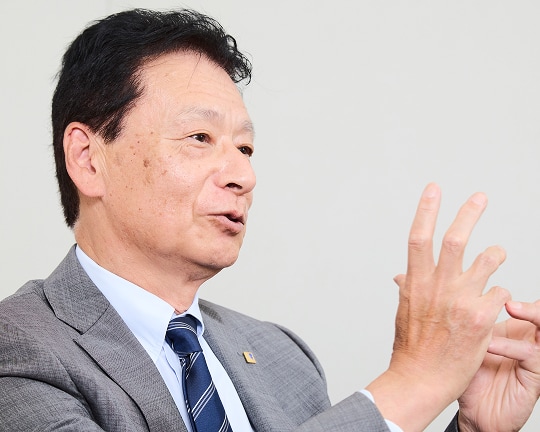
Ikeda: We’re now midway through Phase 2 of our ten-year SHIFT2030 plan. The weaker yen has helped, but Nitta has also overcome challenges such as the COVID-19 pandemic and tariff issues. Looking at the numbers, I see steady progress.
Kitamura: Thank you. But I don’t think that meeting our quantitative targets means all is well. Some businesses are further along than others, and behind the numbers, there are still issues we need to tackle for the next stage.
Ikeda: That’s true. If you look more closely, performance is uneven across the businesses. Overseas expansion is starting to show results. But progress on new businesses falls short. We also need to step up growth investment. Precisely because we’re on track overall, we have to be clear about where to drive growth over the next five years.
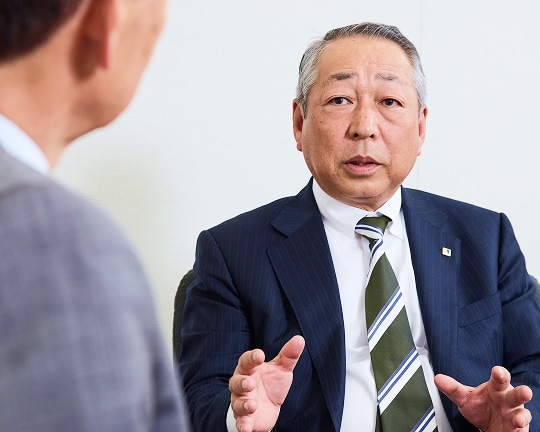
Kitamura: You’re right. The other Outside Directors have also pointed out that “new business initiatives and growth investment are weak.” First, we will clarify our growth strategy. Then, with 2030 in view, we will plan the investments to carry it out, bringing them forward where needed. After all, building facilities takes time these days.
Ikeda: That calls for swift decisions and the ability to follow through. It’s not just about how much we invest, but which businesses we will grow, in which markets, and by when. Our investment needs to be tied to that strategy.
Kitamura: We plan to set out our strategy more clearly at an early stage. We’ve already begun discussions on growth strategy with each business division, separate from our regular meetings. At Board meetings, too, we will seek the views of our outside board members and act on them.
TALK 02“There is still room to grow globally.”─Ikeda
“We will cross business boundaries to open up new markets.”─Kitamura
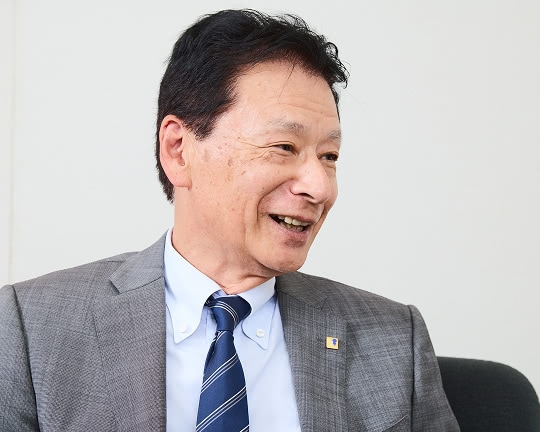
Ikeda: Raising our overseas sales ratio is key to our growth strategy. Compared with companies in similar lines of business, Nitta still has plenty of room to raise it. In that respect, I have high expectations for the Global Business Development Department.
Kitamura: Nitta’s overseas expansion began with the belt business. It’s been about 50 years since we began operating through overseas subsidiaries. We have well-established networks, so we will draw on those resources to expand our newer businesses as well. The Global Business Development Department builds links across the boundaries between our businesses.
Ikeda: If our business divisions can tap into each other’s markets and information, rather than just going overseas separately, we may be able to expand in ways other companies can’t. There’s room to grow if we can get things moving in areas where progress has been difficult.
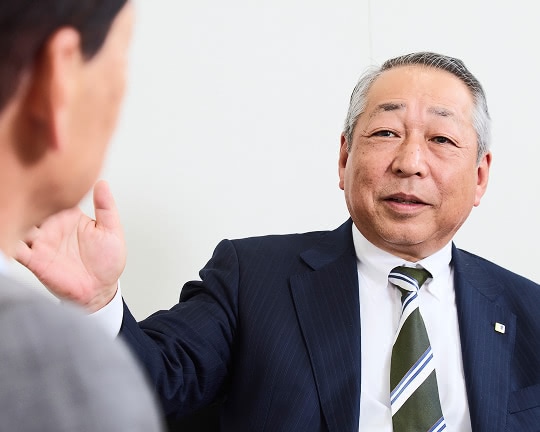
Kitamura: The Global Business Development Department takes a hands-on role in projects that are difficult for a single division to pursue on its own, connecting the people involved. Once a project is under way, the department hands it over to the division and looks for new possibilities in related areas.
Ikeda: Is India a prime example of that global strategy?
Kitamura: Yes, it is. Our new plant there, completed in February 2026, will bring together three businesses: belts, hoses and tubes, and now air filters as well. The Nitta name still isn’t widely known in India. With the new manufacturing base as a starting point, the three businesses will share information and sales channels and build relationships with local customers.
Ikeda: The semiconductor sector is also important for raising our overseas sales ratio.
Kitamura: Yes, semiconductors are another opportunity. With AI driving up equipment demand, we will build on our track record forged through years of working with semiconductor equipment makers to expand our business with their overseas counterparts. Nitta serves this sector through several businesses, including belts as well as hoses and tubes. New opportunities are now emerging even in overseas projects where our products haven’t been adopted on a large scale so far. We will keep adding to our track record, one project at a time. Overseas sales are still only about a third of our total sales. We will make sure that share grows.
Ikeda: On the other hand, new businesses have yet to produce major results. But this is a very difficult area, and other companies are struggling too. Aiming for a big leap also means taking on significant risk. Rather, I think we also need to take a fresh look at our core business and related areas.
Kitamura: That’s very much in line with the thinking behind SHIFT2030. Instead of aiming blindly for a leap, we build on our existing core technologies and know-how and expand from there in various ways. We’re taking the same approach to expanding the use of new technologies such as Namd™. First, we will strengthen our core businesses and generate profits to fund growth investment. Then we will take the experience we’ve gained in Japan to overseas markets and find new applications and related products.
Ikeda: Our businesses in Hokkaido also have interesting potential. They’re by no means large, but they could link the forest assets we’ve held since our founder’s time to our business today, generating a certain level of profit while making Nitta better known through sales to consumers. The key is to go beyond social contribution and make them sustainable as businesses.
Kitamura: Our maple syrup production and sales business in Hokkaido grew out of a proposal from our employees. By tapping yama-momiji and itaya-kaede maples in our own forests, we became the first in Japan to produce maple syrup on a full commercial scale. It’s still a small business, but demand is so strong that production can’t keep up. Our first step is to grow it steadily to a scale where it can turn a profit. We will also explore possibilities within our Hokkaido businesses as a whole, including cheese production.
TALK 03“It is people who drive our growth strategy.”─Ikeda
“We will build an environment true to Nitta, one where diverse talents can thrive.”─Kitamura
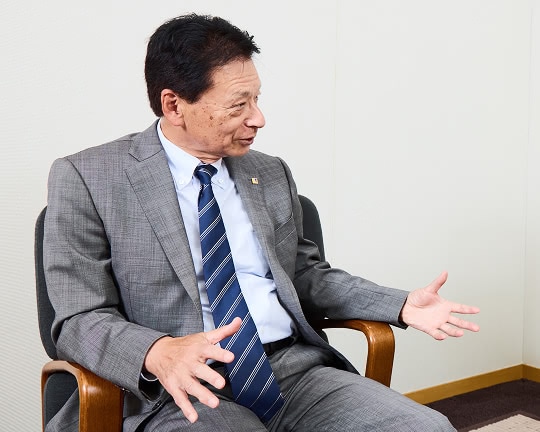
Ikeda: People are essential to those efforts, both in Japan and globally. Partly because of Japan’s declining birthrate, companies are finding it hard to hire new graduates. The question is how we can make the most of mid-career hires, foreign nationals, women, and older employees in a way that’s true to Nitta. Beyond hiring more people, it’s important that we draw on the experience and networks of those who come on board.
Kitamura: In 2026, talented engineers from India and Vietnam are set to join us. At our subsidiary in China, we have someone who studied in Japan serving as general manager. I believe moves like these will spark positive chemistry within Nitta.
Ikeda: For our businesses to take root overseas, it’s not enough to keep sending people from Japan. We need to think about how local people can eventually run these businesses.
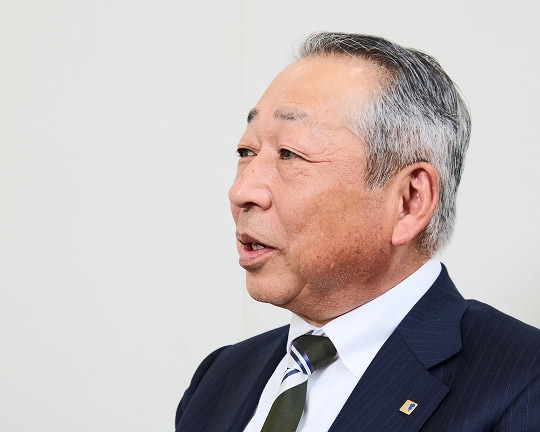
Kitamura: Looking ahead, I would like local people to lead more of our overseas locations, including India.
Ikeda: The new personnel system has also been in place since FY2024. We should keep reviewing it, building on Nitta’s own approach to employment while helping motivated, capable people contribute more fully.
Kitamura: We’re surveying employees about the new personnel system and asking what arrangements would make it easier for them to work. Introducing the system isn’t the end of it. We will keep improving it while checking how it’s actually being received.
Ikeda: Listening to the people who actually do the work and adapting the system to fit Nitta, rather than adopting other companies’ systems as they are—that’s the kind of steady effort I think matters.
Kitamura: I believe that when our people grow, the Group grows with them. We will keep building an environment where a diverse range of people can make the most of their abilities.
TALK 04“Nitta’s culture of sincerity and care will prove its worth.”─Ikeda
“We will keep practicing sustainability in a way that is true to Nitta.”─Kitamura
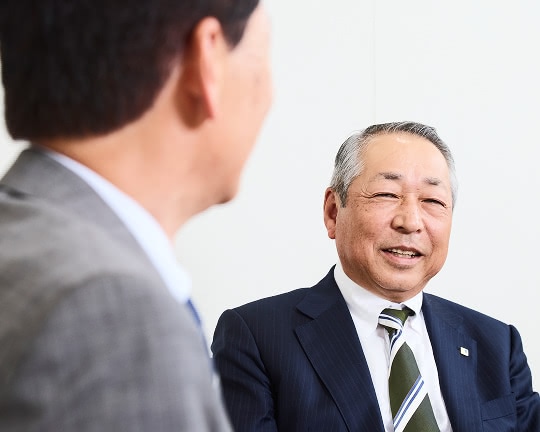
Ikeda: What I’ve valued throughout my long career is “not winning too much.” Even when you could make more profit, you leave a little for those around you. In the long run, that benefits you as well. I think that kind of culture has always been part of Nitta. I see sincerity and care in the way it works. Nitta has remained a company valued by society for a full 141 years because that approach has served it well. Perhaps that, in itself, is what sustainability management means at Nitta.
Kitamura: I think that ties in directly with “utmost sincerity,” the principle our founder held dear. This commitment to always responding with integrity also shows in our forestry business. Our founder planted trees after logging. For a manufacturer to even consider resource cycles must have been unusual at the time. From there, we create products that serve society. Sustainability is something we’ve practiced all along.
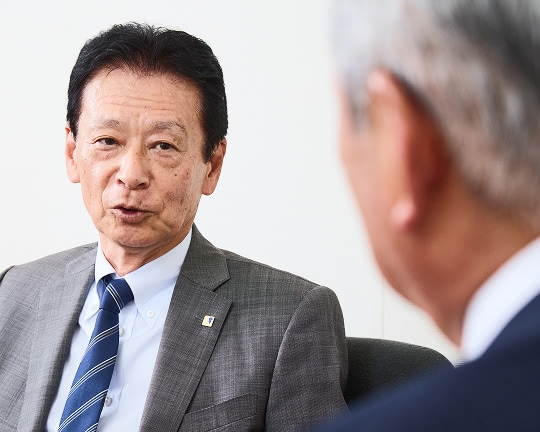
Ikeda: Even as times change rapidly, we should keep refining the qualities that have come to define Nitta, while adapting our systems and organization as needed. I think that’s what will lead to sustainable growth.
Kitamura: I agree. Trust is, after all, an important asset for Nitta. In that sense, I believe sustainability for us right now means, above all, meeting our responsibility to maintain supply. At present, tariff and oil issues are causing raw material shortages and pushing up prices. Even so, every department is doing everything it can to make sure our customers receive what they need. I believe that continuing to meet that responsibility, whatever the circumstances, is the foundation of trust.
Ikeda: With the external environment this turbulent, we can’t prevent every problem through our own efforts alone. Still, understanding the situation accurately and acting quickly where we can will protect that trust.
Kitamura: To that end, procurement is leading our efforts to gather information and negotiate with the parties involved to secure the materials we need. The relationships we’ve built with our business partners in normal times and the information each department holds come into their own at moments like these.
Ikeda: When the business environment changes this sharply, industry realignment and new alliances tend to follow. That’s when companies with room to maneuver, financially and otherwise, are the ones that can take the next step. I believe Nitta is well positioned to do just that. I would encourage you to stay alert to developments around you and keep up your steady progress. I have high hopes for Nitta.
Kitamura: We need not only to protect the strengths we’ve built up over the years, but to put them to work for our next stage of growth. We will cross the boundaries between businesses and regions, make the necessary decisions, and carry them out.
Ikeda: Now that you’re in your second year as President, I think we will see more of your own style of leadership. I’m looking forward to it.
Kitamura: Mr. Ikeda, you’ve gained extensive experience in finance and other fields quite different from our world of manufacturing. At Board meetings, too, you offer views from angles we would never have considered. I hope you will continue to give us your tough feedback. With that as my guide, I will make decisions and follow through.