Sustainability
Message from the President
Message from the President
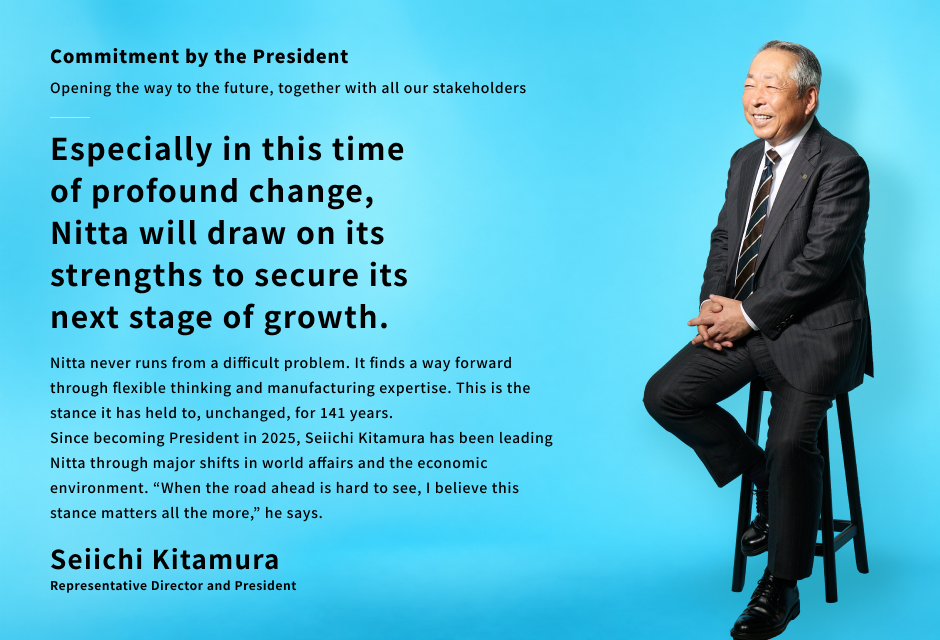
Looking back on FY2025, how do you see where Nitta stands today?Overall, we met our quantitative targets.
At the same time, the challenges ahead came into clear view.
FY2025 (April 1, 2025–March 31, 2026) was the first year of Phase 2 of the SHIFT2030 Medium- to Long-Term Business Plan. We broadly achieved our quantitative targets, including net sales and operating income. That said, progress varied from business to business, and some targets remain unmet. The overall figures were also lifted by the weaker yen, so we cannot look at them and conclude that everything is on track.
Our mainstay belt and rubber products business continued to perform solidly. For the hose and tube products business, which had long struggled, the picture has changed. Driven by AI, semiconductor-related capital investment expanded worldwide, and from the second half of the fiscal year, orders for related products rose noticeably. We have been serving the semiconductor industry for a long time. Even when the market was sluggish, we stayed focused on our customers’ applications and the challenges they faced, steadily developing our products and technologies. I believe those years of work are beginning to pay off as we capture growing demand in Japan and overseas.
On the other hand, some areas remain sluggish, and others are making little headway. We should acknowledge what we have achieved. But we must also look closely at the issues facing each business and product, and not gloss over them. That is what leads us to our next decisions and actions. For example, our Group company Nitta Chemical Industrial Products has pursued “selection and concentration” across its businesses and products through steps such as withdrawing from low-profit businesses and consolidating production sites. As a result, its net sales and profit were lower than in the previous fiscal year, but it is steadily building a stronger foundation for generating profit. We need to see these reforms through and redirect our resources to areas with prospects for profitability and growth. In my view, we now see more clearly what must be done for our next stage of growth.
Phase 2 and the road to FY2027: what will you focus on, and how?We will make our existing businesses stronger still,
add new businesses and products, and become more global.
To achieve our Phase 2 targets, and beyond them our targets for 2030, we need to grow sales and improve profitability at the same time. Our performance through the first year of Phase 2 has been broadly in line with our plan. But I do not believe that simply carrying on as we are will be enough to reach our FY2027 and FY2030 targets. We need to make our existing businesses stronger, add new products and businesses, and expand into growth markets. And we will pursue all of this on a more global scale than ever before.
The key is collaboration across the boundaries between our business divisions. At Nitta, each business has developed its own technologies and markets. Over many years of overseas expansion, our belt business in particular has built relationships with many business partners and developed sales networks and know-how in each region. These are important assets that the whole Group should draw on. We will extend our relationships with customers, distributors, and other partners to the rest of our businesses and offer a broader range of technologies and products. In this way, we will build links that cut across our businesses.
A small piece of information picked up through contact with a customer in one business can sometimes be linked to another business’s technologies or products and lead to a new proposal. We will turn the relationships and information we have built up over many years into strength for the whole Group, rather than keeping them within individual businesses.
At the center of this effort is the Global Business Development Department, which we established in 2024. The department is not there to do the business divisions’ work for them. Instead, it links the sales networks, market information, and manufacturing know-how they have each built up, creating new ways for them to work together and draw on one another’s strengths. One of its important roles is to act as a bridge between business divisions and overseas locations to advance projects that were previously difficult for a single division to pursue on its own. Another is to seek out new markets and customers and find opportunities beyond the scope of our existing businesses. It also helps develop people who can work globally, through practical experience overseas and collaboration with our local operations.
We are beginning to put this approach into practice in India. Building on the local subsidiary we established in 2012, we completed a new plant there in February 2026. The plant brings together three businesses at one site: belt and rubber products, hose and tube products, and air conditioning products. These businesses are working to share information, sales channels, and manufacturing and logistics functions. We will develop our local teams and ways of working, moving step by step toward operations they can manage autonomously. Completing the new plant is not the finish line. It is the start of our efforts as a Group to expand into markets that were previously difficult for a single business to reach on its own.
We are beginning to put this approach into practice in India. Building on the local subsidiary we established in 2012, we completed a new plant there in February 2026. The plant brings together three businesses at one site: belt and rubber products, hose and tube products, and air conditioning products. These businesses are working to share information, sales channels, and manufacturing and logistics functions. We will develop our local teams and ways of working, moving step by step toward operations they can manage autonomously. Completing the new plant is not the finish line. It is the start of our efforts as a Group to expand into markets that were previously difficult for a single business to reach on its own.
Above all, we need to make our growth strategy concrete and follow through on the investments it requires, bringing them forward wherever possible. It takes time to put new equipment into operation after an investment is planned. If we delay a decision, we also delay the results. We look ahead to changes in technology and markets, and listen closely to our customers for hints of needs that are still taking shape. We then identify the areas where we can draw on the technologies and relationships we have built, and make the necessary investments. Once an investment is made, we review the results and revise our strategy as needed. We will keep building on this work as we move toward FY2030 and beyond.
We must also keep in mind that the capital we invest has to produce results. We use business ROIC, which we added to our quantitative targets in Phase 2, as a common indicator. Alongside sales and profit, we look at how much capital we have invested in each business and product, and what returns that capital is generating. Our aim is not simply to scale back or withdraw from low-profit areas. It is to reallocate the resources this frees up to other areas where we expect future growth. We will manage our business with a disciplined focus on capital efficiency. We will clearly explain our thinking and progress to our investors, along with our approach to shareholder returns centered on stable dividends.
Toward 2030 and beyond: how will Nitta continue to grow?With the asset of trust and the people who uphold it,
we will achieve our next stage of growth in challenging times.
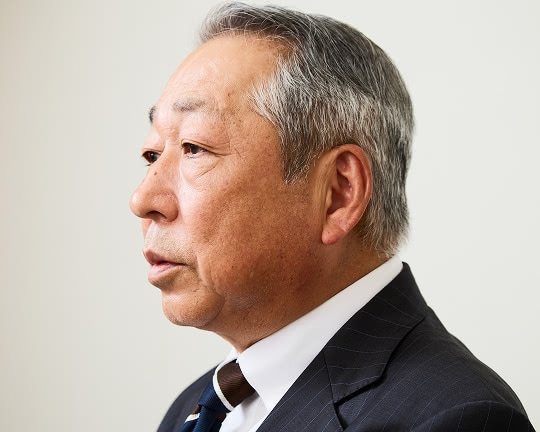
What has sustained Nitta’s growth, I believe, is our people’s sincere dedication to meeting customers’ expectations. As an engineer, I too would often find myself trying one approach after another to meet difficult requests from customers in Japan and overseas. I remember addressing new requirements for belts used to carry mail in Japan, and rethinking products for logistics equipment in North America from the ground up. Of course, there was only so much I could do on my own. Colleagues in engineering, manufacturing, and sales each played their part, and we overcame the challenges one by one. Even when other companies had been unable to solve a problem, we kept at it as a team until we finally developed a product that solved it. It was a great joy to meet our customers’ expectations in this way and to know that they valued our work. What is more, the trust we earned led to other projects as well. I learned that each success earns trust, and that doing this again and again is how a business is built.
Trust has sustained Nitta’s business for 141 years. It is one of our most valuable assets. Our founder placed great value on acting with sincerity, and that spirit still runs through our work. When a problem arises, colleagues do not leave the person in charge to deal with it alone. They reach out, offer ideas, and help one another. Many of them have helped me in just this way. People shaped by this culture do dependable work in their fields and build lasting relationships of trust. That is why we will continue to devote time and effort to developing our people.
I encourage our people to focus first on their immediate goals while also setting goals for who they want to be in 10 or 20 years. I hope that, with this long-term perspective, they will grow by taking small steps each day: learning something today that they did not know yesterday and doing one thing they could not do before.
There is more than one path to growth. Even when people share the same goal, I believe each person should be able to find their own way of reaching it. We provide opportunities for them to do so and keep a supportive eye on their progress. I want to continue nurturing a culture where our people feel safe to keep taking on challenges and can put their individual strengths to work.
Our work is to create products that contribute to society. We do that through continual invention and innovation, and through good human relationships. Times may change, but I am convinced that this is the path to new products, new businesses, and growth.
Throughout its 141-year history, the Nitta Group has kept pursuing new technologies and businesses in response to changes in society. People and trust have always been at the heart of that work. My responsibility as President is to make sure that the technologies, networks, people, and trust we have built up over the years lead to our next stage of growth. I will see that through.